TEAS 7 Chemistry Crash Guide: Balancing Equations, pH & Bonds

Chemistry Is Predictable — Use That
Chemistry makes up roughly a fifth of the TEAS Science section — about 8 questions — and it ambushes students who spent all their time on anatomy. Here is the reassuring part: TEAS chemistry is high-school general chemistry with no organic molecules, no thermodynamics, and no advanced math. Six self-contained topics cover nearly every question, and each one runs on a small set of rules. Learn the rules and this becomes one of the easiest places to bank Science points.
This crash guide covers all six topics in study order — atomic structure, the periodic table, bonding, reactions and balancing, acids and bases, and solutions — with worked examples in true exam style.
Atomic Structure: Protons Define Everything
| Particle | Charge | Location | Mass |
|---|---|---|---|
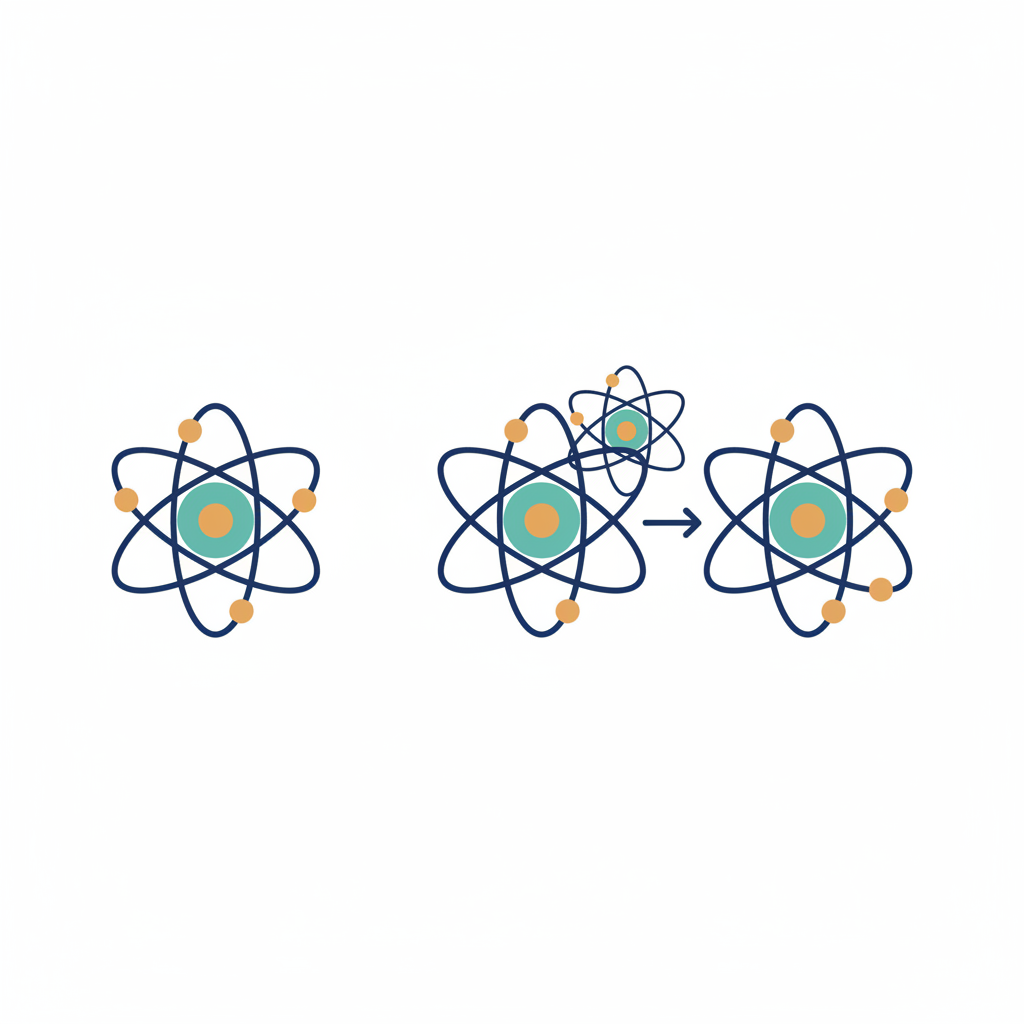
| Proton | Positive | Nucleus | About 1 amu |
| Neutron | Neutral | Nucleus | About 1 amu |
| Electron | Negative | Shells around nucleus | Nearly zero |
Three numbers define any atom. The atomic number equals the proton count and identifies the element — every carbon atom has 6 protons, no exceptions. The mass number equals protons plus neutrons. Atoms of one element with different neutron counts are isotopes. Atoms that gain or lose electrons become ions: cations are positive (lost electrons), anions are negative (gained electrons). A handy memory hook: cats have paws — cations are positive; an anion sounds like "a negative."
The Periodic Table: Read It, Don't Memorize It
You will not need to recite the table, but you must read its organization. Horizontal rows are periods (each row adds an electron shell); vertical columns are groups whose members share properties because they carry the same number of valence electrons. Know the four famous groups: alkali metals (Group 1, one valence electron, very reactive), alkaline earth metals (Group 2, two valence electrons), halogens (Group 17, seven valence electrons, reactive nonmetals), and noble gases (Group 18, full shells, inert). Metals sit left of the stair-step line, nonmetals right — and that position predicts bonding, which comes next.
Chemical Bonding: Transfer or Share
| Bond | What happens | Forms between | Example |
|---|---|---|---|
| Ionic | Electrons transfer | Metal + nonmetal | NaCl table salt |
| Covalent | Electrons shared | Nonmetal + nonmetal | H2O water |
| Hydrogen | Weak attraction | H with O, N, or F | Between water molecules |
The one-line test for any bonding question: transfer means ionic, share means covalent. Atoms bond to fill their outer shell — the octet rule of eight valence electrons. When sodium (a metal) meets chlorine (a nonmetal), sodium donates an electron and they lock together ionically; when two nonmetals like hydrogen and oxygen meet, they share instead.
Reactions and Balancing Equations
Learn the five reaction patterns by shape, since the exam often asks you to classify rather than compute:
| Type | Pattern | Example |
|---|---|---|
| Synthesis | A + B → AB | 2H2 + O2 → 2H2O |
| Decomposition | AB → A + B | 2H2O → 2H2 + O2 |
| Single replacement | A + BC → AC + B | Zn + 2HCl → ZnCl2 + H2 |
| Double replacement | AB + CD → AD + CB | AgNO3 + NaCl → AgCl + NaNO3 |
| Combustion | Fuel + O2 → CO2 + H2O | CH4 + 2O2 → CO2 + 2H2O |
Balancing obeys the law of conservation of mass: atoms are never created or destroyed, so each element needs equal counts on both sides. Adjust only the coefficients (big numbers in front) — never the subscripts inside formulas. Worked example: H2 + O2 → H2O is unbalanced (2 oxygen left, 1 right). Put 2 before water (2H2O gives 4 H, 2 O), then 2 before H2: 2H2 + O2 → 2H2O. Check: 4 hydrogen and 2 oxygen on each side. Balanced.
Acids, Bases, and the pH Scale
| Property | Acids | Bases |
|---|---|---|
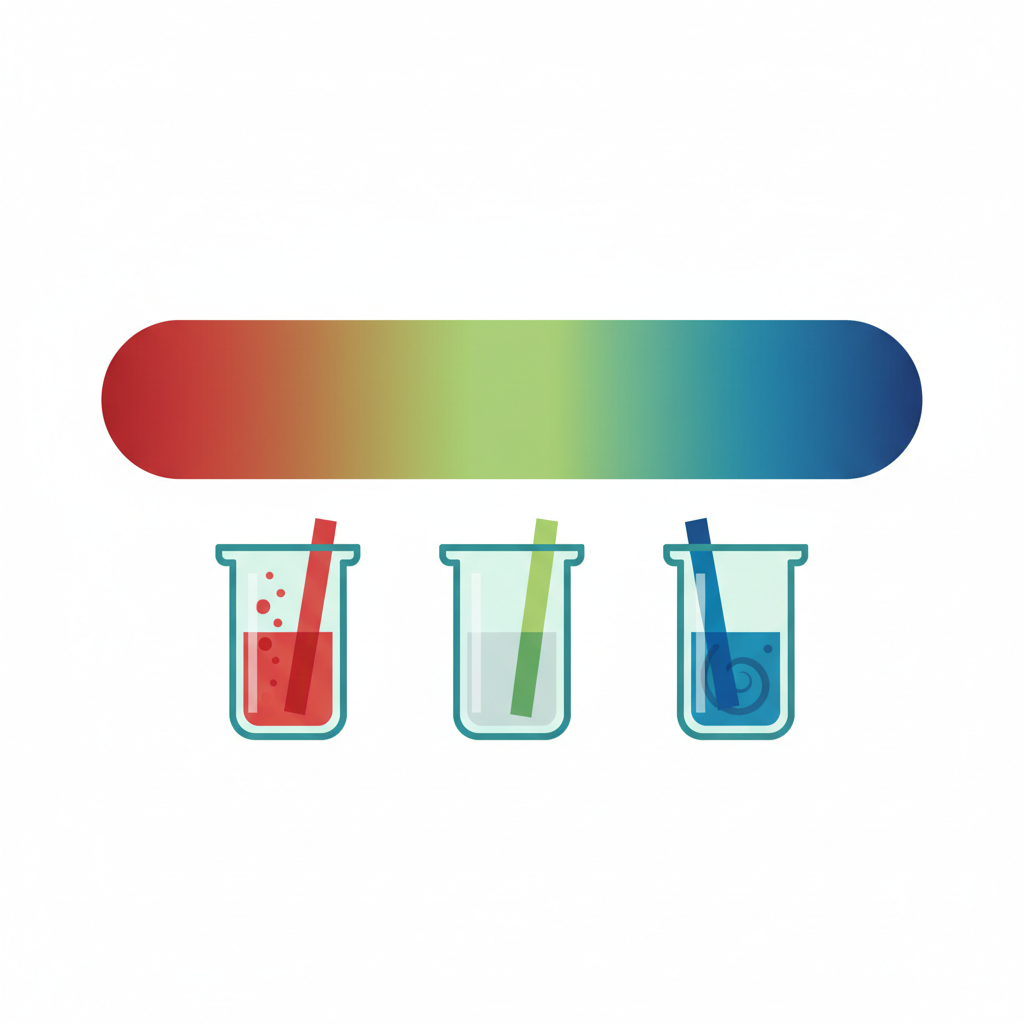
| pH | Below 7 | Above 7 |
| Hydrogen ions | Donate H+ | Accept H+ |
| Taste and feel | Sour | Bitter, slippery |
| Litmus paper | Turns red | Turns blue |
| Examples | HCl, vinegar, citrus | NaOH, ammonia, soap |
The pH scale runs 0 to 14 and is logarithmic: each whole-number step means a tenfold change in hydrogen-ion concentration. A pH 3 solution is ten times more acidic than pH 4 — and a pH 2 solution is 10 × 10 × 10 = 1,000 times more acidic than pH 5. Pure water is neutral at 7, and human blood is held near 7.4 by bicarbonate buffers. An acid plus a base undergoes neutralization, producing salt and water: HCl + NaOH → NaCl + H2O.
Solutions, Concentration, and States of Matter
A solution is a solute dissolved in a solvent, and concentration is usually given as molarity: moles of solute per liter of solution. Adding solvent dilutes the solution and lowers molarity. Reactions that release energy are exothermic; those absorbing energy are endothermic. For states of matter, remember the particle story: solids hold fixed shape and volume with vibrating packed particles, liquids keep volume but take the container's shape, and gases fill both. Melting or boiling changes form only (physical change); burning or rusting creates a new substance (chemical change).
5 Traps That Catch Chemistry Students
- Changing subscripts to balance. Only coefficients move — touching subscripts rewrites the substance itself.
- Treating pH as linear. Every unit is a factor of ten, not one more unit of acidity.
- Forgetting the pulmonary-style exceptions. Not chemistry, but the same lesson: definitions have edge cases, and the TEAS loves them.
- Confusing mass number with atomic mass. Mass number is protons plus neutrons in one atom; atomic mass is the weighted average across isotopes.
- Calling dissolving a chemical change. Salt in water is still salt and water — no new substance, so it is physical.
Study Checklist
- Compute protons, neutrons, and electrons for any element from its atomic number and mass number.
- Classify any bond as ionic or covalent from the elements involved.
- Balance a synthesis or combustion equation using coefficients only.
- Calculate pH strength differences as powers of ten.
- Sort any change as physical or chemical with one reason.
Chemistry rewards rule-learners. Six topics, a handful of patterns, and consistent practice with balancing and pH math will convert this ambush section into reliable points.
Frequently Asked Questions
Related Posts
View all articles
10 TEAS Mistakes That Cost Points (and How to Avoid Every One)
The 10 TEAS mistakes behind most lost points: planning, study strategy, execution, and test-day errors, plus an anti-mistake checklist.

Beat TEAS Test Anxiety: A Per-Section Pacing Plan That Works
Beat TEAS test anxiety with exact per-section pacing budgets, panic-proof preparation habits, and a 30-second mid-exam recovery protocol.

TEAS for LPN Programs: Scores, Paths & a 4-Week Plan
TEAS for LPN programs: realistic score targets, LPN vs RN paths, and a focused 4-week study plan for working adults.