TEAS Study Schedule: 2, 4, or 6 Weeks

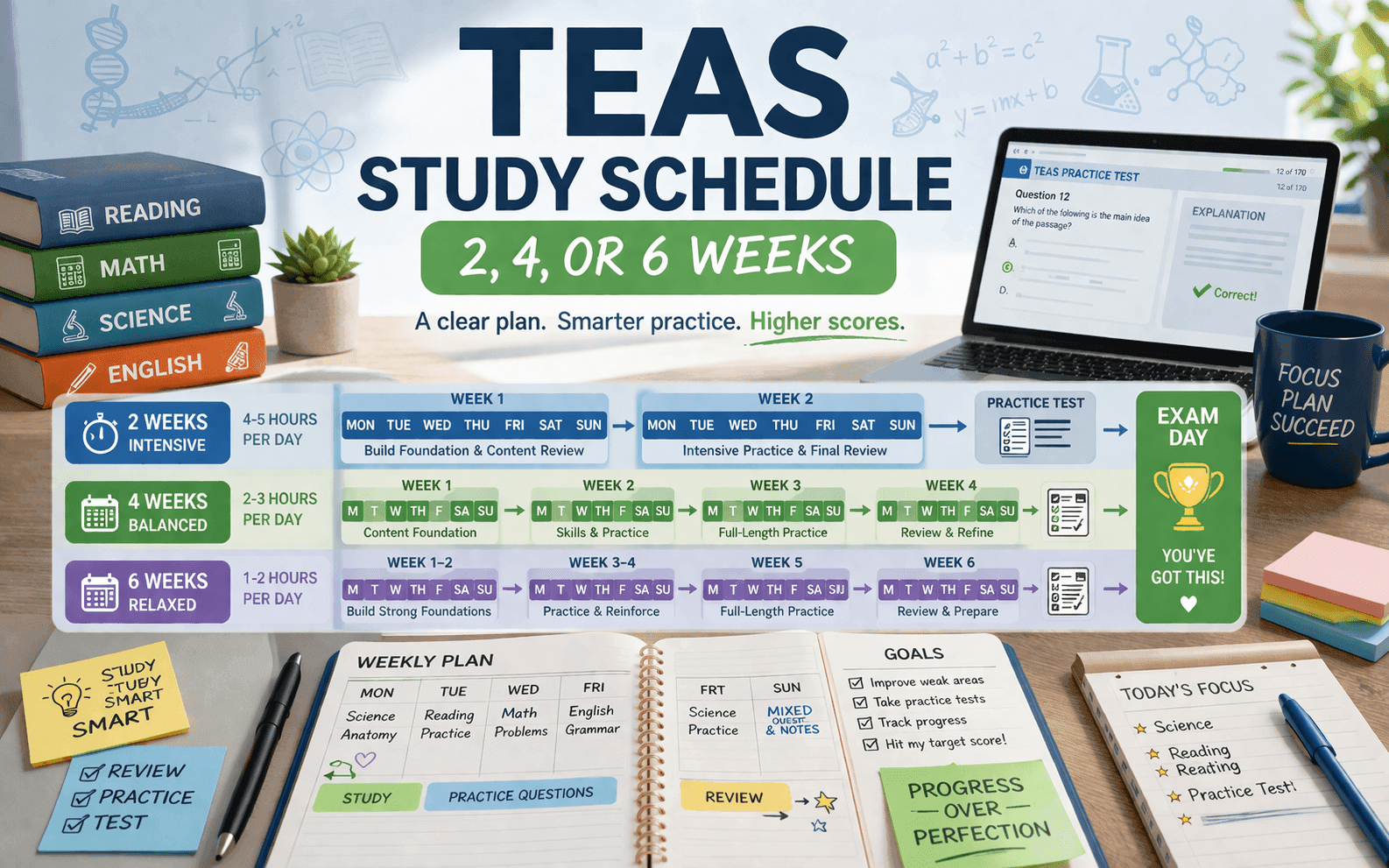
One of the most common questions TEAS test-takers ask is: "How long should I study for the TEAS?" The honest answer is: it depends on your starting point, your target score, and how much time you can commit daily.
This guide breaks down three proven study schedules—a 2-week intensive, a 4-week standard plan, and a 6-week relaxed approach. Each schedule includes weekly goals, daily priorities, and specific action items to keep you on track.
Before choosing a timeline, take a free TEAS practice test to assess where you stand. Your diagnostic score will determine which schedule makes the most sense for you.
Choosing Your TEAS Study Timeline
The right timeline depends on three factors:
| Factor | 2-Week Plan | 4-Week Plan | 6-Week Plan |
|---|---|---|---|
| Daily time available | 4-5 hours | 2-3 hours | 1-2 hours |
| Diagnostic score range | 65%+ | 50-65% | Below 50% |
| Target score | Moderate (70-80%) | Competitive (80-85%) | Exemplary (85%+) |
| Previous knowledge | Strong foundation | Some gaps | Significant gaps |
Choose 2 weeks if you scored 65%+ on your diagnostic, can study full-time, and your target school has moderate requirements.
Choose 4 weeks if you have 2-3 hours daily, scored between 50-65%, or want a competitive edge for selective programs.
Choose 6 weeks if you scored below 50%, need to rebuild foundational knowledge, study while working or attending class, or want to maximize your score.
The 2-Week TEAS Study Schedule
This is an intensive sprint. Only choose this option if you have a strong foundation and can dedicate significant daily hours.
Week 1: Foundation and High-Yield Review
| Day | Focus | Action Items |
|---|---|---|
| Day 1 | Diagnostic + Planning | Take full diagnostic test. Identify weak areas. Create priority list. |
| Day 2 | Science (Anatomy Focus) | Review body systems, organ functions, homeostasis. 2.5 hours content, 1 hour practice questions. |
| Day 3 | Science (Bio + Chemistry) | Cell biology, genetics, macromolecules, atomic structure, pH scale. 2.5 hours, 1 hour practice. |
| Day 4 | Reading Comprehension | Main ideas, author's purpose, inference skills, text structure. 2 hours content, 1.5 hours practice. |
| Day 5 | Mathematics | Fractions, decimals, ratios, proportions, basic algebra, word problems. 2.5 hours, 1 hour practice. |
| Day 6 | English and Language Usage | Grammar rules, punctuation, sentence structure, vocabulary. 2 hours, 1 hour practice. |
| Day 7 | Full Practice Test | Take timed full-length practice test. Review all answers (right and wrong). |
Week 2: Intensive Practice and Review
| Day | Focus | Action Items |
|---|---|---|
| Day 8 | Targeted Review | Focus on sections where you scored below 70% on practice test. |
| Day 9 | Mixed Practice | Complete 50-75 practice questions across all sections. |
| Day 10 | Science Deep Dive | Review difficult science concepts. Focus on anatomy diagrams and chemistry fundamentals. |
| Day 11 | Reading + Math Focus | Practice passages and math word problems. |
| Day 12 | English + Vocabulary | Grammar drills, commonly confused words, sentence corrections. |
| Day 13 | Light Review + Relaxation | Quick review of formulas and key concepts. No new material. |
| Day 14 | TEAS EXAM DAY | Review your cheat sheet in the morning. Relax before the test. |
Key strategy for 2 weeks: Minimize new content after Day 5. Spend 80% of your time on practice questions and reviewing explanations. Understanding why you got something wrong is more valuable than seeing new material.
The 4-Week TEAS Study Schedule
This is the most popular timeline and works well for most students. Four weeks allows for thorough content review while maintaining a sustainable pace.
Week 1: Content Foundation
| Day | Morning (90 min) | Evening (90 min) |
|---|---|---|
| Day 1 | Take diagnostic test | Review results, create study plan |
| Day 2 | Reading: Key ideas and details | Reading: Craft and structure |
| Day 3 | Math: Numbers and algebra basics | Math: Fractions and decimals |
| Day 4 | Science: Anatomy overview | Science: Body systems |
| Day 5 | Science: Biology (cells, genetics) | Science: Chemistry basics |
| Day 6 | English: Grammar fundamentals | English: Punctuation rules |
| Day 7 | Rest day | Light review of weakest area |
Week 2: Deep Dive and Practice
| Day | Morning (90 min) | Evening (90 min) |
|---|---|---|
| Day 8 | Math: Ratios, proportions, percentages | Math: Algebra and equations |
| Day 9 | Reading: Integration of knowledge | Reading: Practice passages |
| Day 10 | Science: Human anatomy deep dive | Science: Physiology and functions |
| Day 11 | English: Sentence structure | English: Vocabulary building |
| Day 12 | Math: Measurement and data | Math: Practice word problems |
| Day 13 | Full practice test | Review answers and explanations |
| Day 14 | Rest day | Light review of problem areas |
Week 3: Targeted Practice and Weak Areas
| Day | Morning (90 min) | Evening (90 min) |
|---|---|---|
| Day 15 | Science: Scientific reasoning | Science: Review difficult concepts |
| Day 16 | Reading: Inference and conclusions | Reading: Evaluate arguments |
| Day 17 | Math: Geometry and conversions | Math: Calculator efficiency practice |
| Day 18 | English: Common errors | English: Paragraph editing practice |
| Day 19 | Practice questions (all sections) | Focus on multiple-select questions |
| Day 20 | Section practice test: Science | Review Science answers |
| Day 21 | Rest day | Light formula review |
Week 4: Final Preparation
| Day | Morning (90 min) | Evening (90 min) |
|---|---|---|
| Day 22 | Full practice test | Detailed answer review |
| Day 23 | Target weak sections | Review explanations |
| Day 24 | Mixed practice questions | Focus on time management |
| Day 25 | Reading + English review | Grammar and vocabulary drills |
| Day 26 | Science + Math review | Formula and concept review |
| Day 27 | Light review only | Prepare test-day materials |
| Day 28 | Rest and relaxation | Early bedtime before exam |
Key strategy for 4 weeks: Spread content review across weeks 1-2, shift to practice in weeks 3-4. This spaced repetition approach helps information stick better than cramming.
The 6-Week TEAS Study Schedule
This relaxed timeline is ideal for working students, those rebuilding foundational knowledge, or anyone wanting maximum confidence on test day.
Week 1-2: Building Foundations (Content Review)
Primary focus: Learning and understanding core content across all four sections.
Weekly structure:
- Dedicate 60-75 minutes daily to one primary section
- Spend 30-45 minutes on a secondary review section
- Take notes by hand—writing improves retention
- Use the ATI TEAS study guide as your primary resource
Week 1 focus areas:
- Days 1-3: Reading comprehension strategies and key ideas
- Days 4-5: Math fundamentals (order of operations, fractions)
- Days 6-7: Science: Anatomy and body systems introduction
Week 2 focus areas:
- Days 8-10: Math: Decimals, ratios, percentages, proportions
- Days 11-13: Science: Biology (cells, genetics, macromolecules)
- Day 14: Rest day
Week 3-4: Expanding Knowledge and Practice
Primary focus: Deepening content understanding and introducing practice questions.
Weekly structure:
- 45-60 minutes content review
- 60-90 minutes practice questions
- Start taking section-specific practice tests
- Review every answer explanation thoroughly
Week 3 focus areas:
- Science: Chemistry (atomic structure, pH, chemical reactions)
- Reading: Author's purpose, bias, and text structure
- English: Grammar rules and sentence structure
Week 4 focus areas:
- Math: Algebraic equations, word problems, data interpretation
- English: Punctuation, vocabulary in context
- Full-length practice test by end of Week 4
Week 5: Intensive Practice
Primary focus: Practice tests, error analysis, and targeted review.
Weekly structure:
- Take 2-3 full-length practice tests
- Spend equal time reviewing answers as taking tests
- Create an error log tracking every mistake
- Focus on understanding why answers are correct, not just memorizing
Recommended practice test schedule:
- Tuesday: Full practice test (timed)
- Wednesday: Detailed review of all answers
- Thursday: Targeted review of weak areas
- Friday: Another full practice test
- Weekend: Light review, rest
Week 6: Final Preparation
Primary focus: Confidence building and test readiness.
Weekly structure:
- Light review only—no new material after Day 5
- Take one final practice test 3-4 days before exam
- Review your cheat sheet formulas
- Simulate test conditions with last practice test
- Prioritize sleep and stress management
Days 1-4: Targeted review based on Week 5 results. Focus on sections scoring below your target.
Day 5: Take final practice test under exact exam conditions (same timing, no breaks except scheduled).
Days 6-7: Light review of formulas and key concepts only. No cramming.
What to Prioritize Regardless of Timeline
No matter which schedule you choose, these priorities remain constant:
High-Priority Content (Every Timeline)
Human Anatomy and Physiology — This is the largest Science section and trips up many students. Spend extra time here.
Reading Comprehension — Reading questions require careful analysis. Practice active reading strategies.
Math Fundamentals — Fractions, decimals, percentages, and ratios appear in multiple question types.
Scientific Reasoning — Understanding experiments, variables, and conclusions is learnable and high-yield.
Lower-Priority Content (If Running Short on Time)
Vocabulary in Context — Build this through reading practice rather than dedicated study.
Detailed Chemistry — Focus on basic concepts; don't deep-dive into complex reactions.
Geometry Formulas — Know area and perimeter; skip complex volume if pressed for time.
Understanding Your Target Score
Different nursing programs have different TEAS requirements. Understanding your target helps calibrate your study intensity.
| Score Level | Score Range | Study Intensity Needed |
|---|---|---|
| Proficient | 58.7-77.3% | Moderate; focus on fundamentals |
| Advanced | 78-91.3% | Significant; balanced preparation |
| Exemplary | 92%+ | Intensive; comprehensive mastery |
Learn more about how TEAS scores are calculated so you understand what each percentage point means for your application.
Final Week Checklist
Whether you're on the 2, 4, or 6-week plan, your final week should include:
- One practice test 3-4 days before exam day
- Review of all formulas and key concepts
- Verification of exam registration and location
- Gathering of required ID and materials
- Planning your test-day route (for in-person exams)
- Early bedtime the night before (8+ hours sleep)
- Light breakfast on exam day
- Confidence in your preparation
Choosing Your Timeline
The best TEAS study schedule is the one you can actually follow. A 6-week plan you complete beats a 2-week plan you abandon halfway through.
If you're unsure which timeline fits your situation:
- Take a diagnostic test — Your starting score is the best predictor of how much time you need.
- Be honest about your schedule — 2 hours daily for 6 weeks beats 5 hours daily for 1 week that you can't sustain.
- Consider your target school — More competitive programs benefit from longer, more thorough preparation.
Ready to start? Take a free TEAS practice test today to establish your baseline, then choose the schedule that matches your results and timeline.
Frequently Asked Questions
Related Posts
View all articles
10 TEAS Mistakes That Cost Points (and How to Avoid Every One)
The 10 TEAS mistakes behind most lost points: planning, study strategy, execution, and test-day errors, plus an anti-mistake checklist.

Beat TEAS Test Anxiety: A Per-Section Pacing Plan That Works
Beat TEAS test anxiety with exact per-section pacing budgets, panic-proof preparation habits, and a 30-second mid-exam recovery protocol.

TEAS for LPN Programs: Scores, Paths & a 4-Week Plan
TEAS for LPN programs: realistic score targets, LPN vs RN paths, and a focused 4-week study plan for working adults.