Mitosis vs. Meiosis + Punnett Squares: TEAS Genetics in 15 Minutes

Genetics in 15 Minutes a Day
Cell division and basic genetics punch above their weight on the TEAS Science section. The concepts are few — mitosis versus meiosis, DNA basics, and Punnett squares — but the exam tests whether you understand outcomes, not just definitions. Students who memorize phase names yet cannot say how many cells each process produces, or with what chromosome count, leave easy points behind.
This guide covers the mitosis-meiosis split the way it is tested, DNA base pairing, Mendel's vocabulary, and step-by-step Punnett squares with the classic ratios worth memorizing.
Mitosis vs. Meiosis: Outcomes First
| Feature | Mitosis | Meiosis |
|---|---|---|
| Daughter cells | 2 | 4 |
| Chromosome number | Diploid (full set, 46 in humans) | Haploid (half set, 23 in humans) |
| Genetically | Identical to parent | Different — genetic variation |
| Divisions | One | Two (Meiosis I and II) |
| Cell types | Somatic body cells | Gametes (sperm and egg) |
| Purpose | Growth and repair | Reproduction |
The memory anchor: mitosis maintains, meiosis makes gametes. Mitosis produces two identical diploid cells for growth and repair; meiosis runs two divisions to produce four genetically unique haploid gametes. Variation in meiosis comes from crossing over — homologous chromosomes swapping segments during prophase I — plus independent assortment.
The Phases Worth Knowing
Mitosis moves through prophase, metaphase, anaphase, and telophase (PMAT), ending with cytokinesis splitting the cytoplasm. Three phase facts cover most questions: the nuclear envelope breaks down in prophase, chromosomes align at the center in metaphase, and spindle fibers pull sister chromatids apart in anaphase. Meiosis II resembles mitosis; the distinctive events — crossing over and homologous pairing — happen in Meiosis I.
DNA Basics: Pairing and Vocabulary
DNA bases pair strictly: adenine with thymine (A–T) and guanine with cytosine (G–C); RNA swaps uracil for thymine. A gene is a DNA segment coding for a trait, and each version of a gene is an allele. Key vocabulary the exam assumes:
- Genotype: the allele pair (for example, Bb). Phenotype: the visible trait (brown eyes).
- Homozygous: two identical alleles (BB or bb). Heterozygous: two different alleles (Bb).
- Dominant: expressed with one copy (capital letter). Recessive: expressed only with two copies (lowercase).
- Diploid (2n): full chromosome set in body cells. Haploid (n): half set in gametes.
Punnett Squares Step by Step
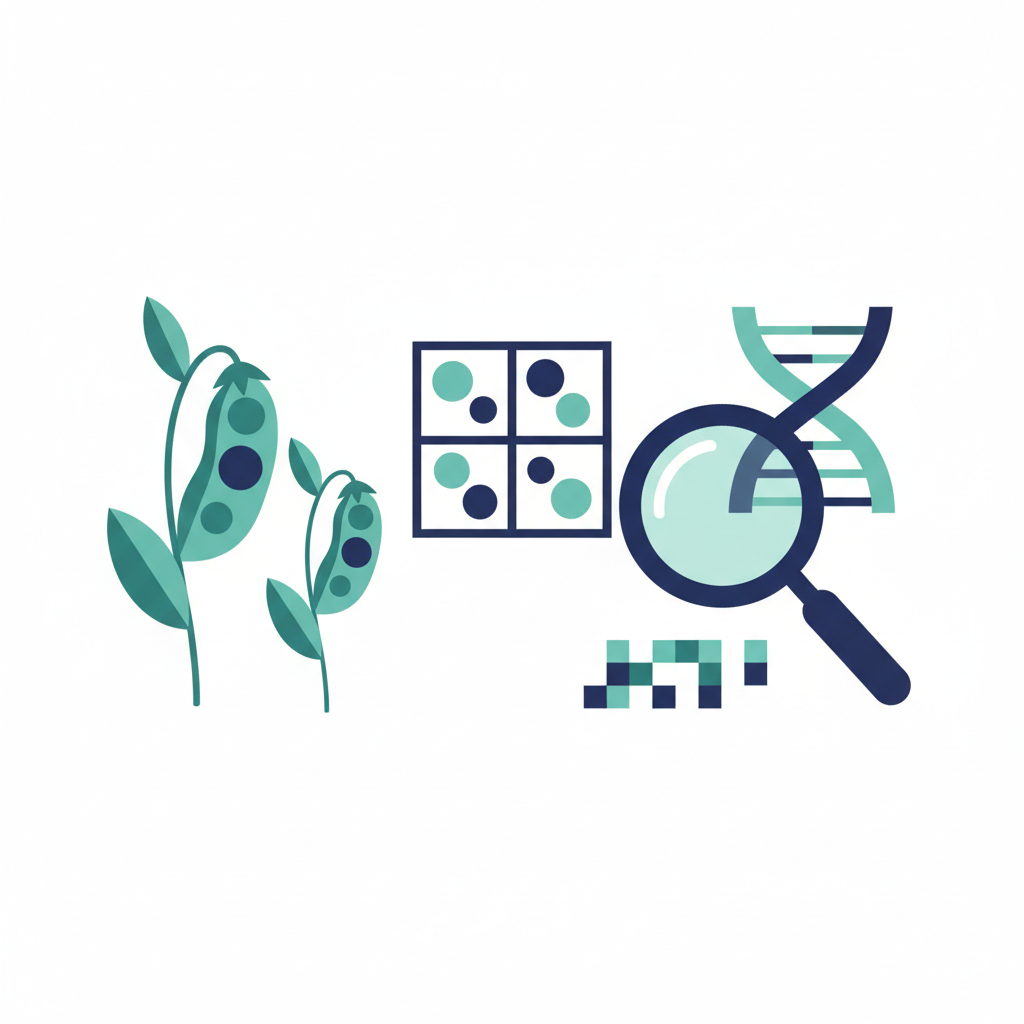
A Punnett square predicts offspring probabilities by combining each parent's alleles. Work it in three steps: place one parent's alleles across the top and the other's down the side, fill each box by combining its row and column allele, then count genotypes and phenotypes.
Worked example: Cross two heterozygous brown-eyed parents (Bb × Bb) with brown (B) dominant over blue (b). Each parent passes B to half its gametes and b to the other half. The square yields 1 BB : 2 Bb : 1 bb — a 1:2:1 genotype ratio — and 3 brown : 1 blue, a 3:1 phenotype ratio. Memorize both ratios; the heterozygous cross is the most tested setup on the exam.
| Cross | Genotype ratio | Phenotype ratio |
|---|---|---|
| Bb × Bb (both heterozygous) | 1:2:1 | 3 dominant : 1 recessive |
| BB × bb | All Bb | All dominant |
| Bb × bb | 1:1 | 1 dominant : 1 recessive |
4 Traps That Catch Genetics Students
- Studying phases instead of outcomes. Questions ask how many cells with what chromosome count far more often than phase names.
- Forgetting which division creates variation. Crossing over happens in prophase I of meiosis — never in mitosis.
- Confusing genotype with phenotype. Bb and BB share a phenotype but differ in genotype; the exam exploits exactly that.
- Assuming a dominant parent guarantees dominant children. Two heterozygous dominant-phenotype parents still produce 25% recessive offspring.
Study Checklist
- Recite the mitosis-meiosis table from memory: cells, ploidy, identical versus varied, purpose.
- Place crossing over in prophase I and state why it matters.
- Pair DNA bases both directions (A–T, G–C) and define all six vocabulary terms.
- Solve a Bb × Bb cross to both ratios without notes.
Genetics is a small topic with a big payoff. Fifteen focused minutes daily on outcomes, vocabulary, and one Punnett square will lock in points that many students surrender.
Frequently Asked Questions
Related Posts
View all articles
10 TEAS Mistakes That Cost Points (and How to Avoid Every One)
The 10 TEAS mistakes behind most lost points: planning, study strategy, execution, and test-day errors, plus an anti-mistake checklist.

Beat TEAS Test Anxiety: A Per-Section Pacing Plan That Works
Beat TEAS test anxiety with exact per-section pacing budgets, panic-proof preparation habits, and a 30-second mid-exam recovery protocol.

TEAS for LPN Programs: Scores, Paths & a 4-Week Plan
TEAS for LPN programs: realistic score targets, LPN vs RN paths, and a focused 4-week study plan for working adults.